Bike maintenance: when to replace each part and how to keep track
A well-kept bike rides smoother, brakes better and leaves you stranded far less often. The catch is that wear is gradual: you get used to the shifting skipping a little or the brakes biting less, and by the time you really notice, the part is long overdue. This guide brings together objective wear indicators, rough lifespan ranges and a simple way to keep track without relying on memory.
Why measure in kilometres instead of by feel
Replacing parts by feel fails in two ways. Replace too early and you throw away material that still had life in it. Replace too late and one worn part drags the others down: a stretched chain eats the cassette and chainrings, and then the repair stops being cheap.
Kilometres are an objective, easy-to-track criterion. They are not perfect, because wear depends on mud, rain, your weight, your power and how well you clean and lube, but they give you a sensible starting point for when to inspect each part closely.
Before you ride: the ABC check
Thirty seconds before rolling out catches most silly problems. It is the ABC rule:
A for air: check tyre pressure and look for cuts, embedded thorns or a visible casing.
B for brakes: squeeze both levers and make sure the bike stops with normal lever travel; look at pad thickness if in doubt.
C for chain (and drivetrain): it should be clean, free of rust and lightly lubricated; turn the pedals a few times and check that the gears shift up and down without skipping.
Many riders add a fourth check: wheels and axles properly tightened, and no play in the bars or seatpost. If something sounds odd, do not leave it for the ride home.
Cleaning and lubing: the routine that most extends part life
You do not need to wash the whole bike after every ride, but you should look after the drivetrain:
Run a rag over the chain to remove surface dirt after dusty or muddy rides.
Every now and then, degrease the chain, cassette and chainrings with a suitable product and rinse them well.
Dry the chain and apply one drop of lube to each link; let it soak in for a few minutes and wipe off the excess with a rag.
Repeat the lubrication regularly: as a rough guide, after wet rides and every few hundred kilometres in the dry, following the lube manufacturer’s advice.
One important detail: lube must never reach the discs or pads. If it contaminates them, the brakes lose bite and the pads may need replacing.
When to replace each part
The ranges below are rough guidelines. They vary a lot with conditions, rider weight, power, weather and upkeep. Use the wear indicators as the final judge.
Chain
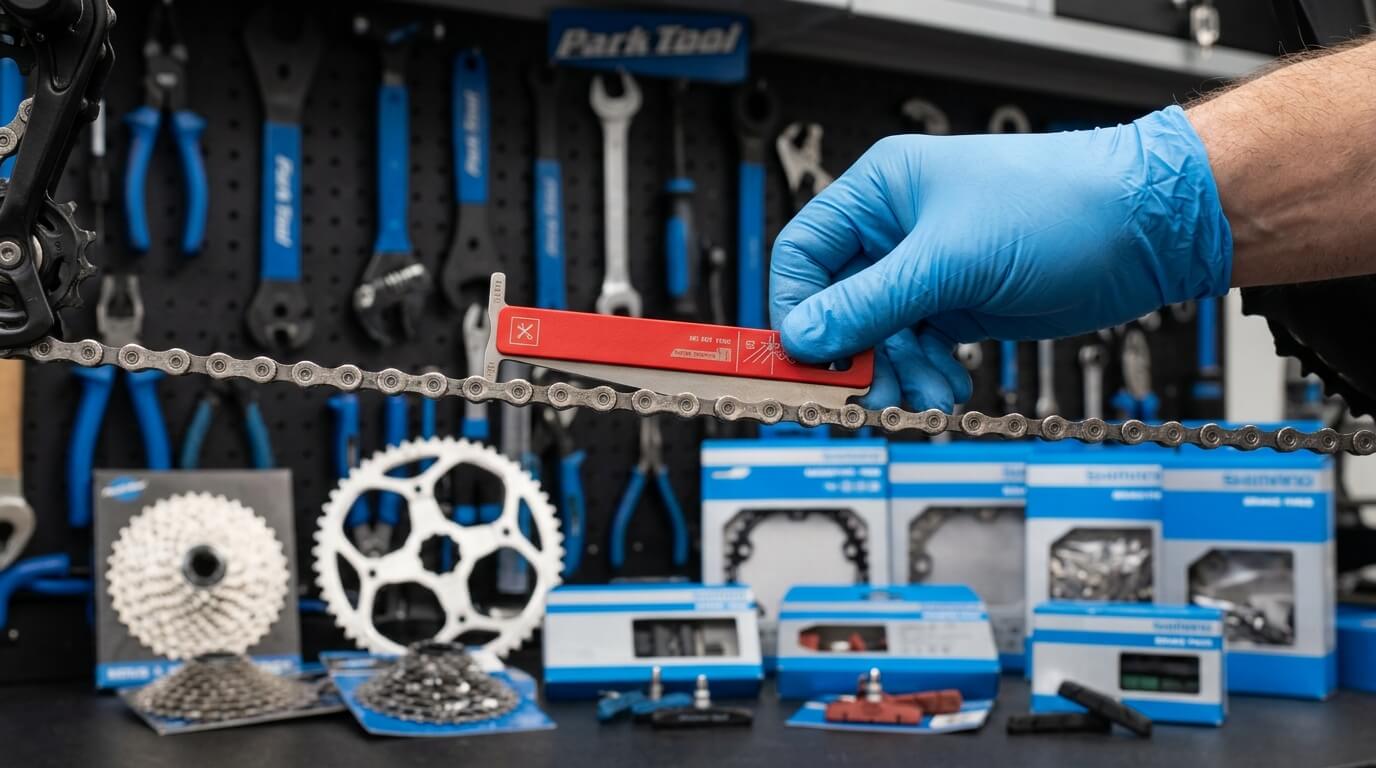
It is the part that wears most and the cheapest to replace, so it is the one to watch. As a reference, it typically lasts between 2,000 and 5,000 km. The reliable method is a chain wear checker: if it reads 0.5% elongation, it is time for a new chain; if it reaches 0.75%, the cassette is most likely damaged too and should be replaced along with the chain. Changing the chain on time can let one cassette outlast two or three chains.
Cassette and chainrings
With chains replaced on time, a cassette often lasts roughly 8,000 to 15,000 km, and chainrings considerably longer. Signs of wear include shark-fin shaped teeth, skipping under hard pedalling with a new chain, and noise on certain sprockets.
Tyres
On the road, a set of tyres usually lasts between 3,000 and 6,000 km, and the rear wears out before the front. Replace them if you see deep cuts, the casing showing through, the tread or wear indicator gone, or if you start getting punctures more often than usual.
Brake pads
This is the most variable range: anything from 1,500 to over 5,000 km depending on terrain, brake type, compound and how much you brake on descents. Replace them when little material is left (check the minimum thickness given by the manufacturer), when the brake squeals persistently, or when it loses bite and does not improve after cleaning.
Cables and housing
If you run mechanical shifting and brakes, cables and housing get dirty and corrode. The usual advice is to renew them about once a year, or sooner if shifting becomes sluggish or the levers feel sticky. Hydraulic and electronic systems have different upkeep, so follow the manufacturer’s guidance.
Bar tape
It matters less for safety than the parts above, but it matters for comfort. A reasonable reference is once or twice a year, or when it is worn, matted or has lost its grip and padding.
How to track it in Cyklot
The most reliable way to stop depending on memory is to let the kilometres count themselves. In Cyklot, the equipment section lets you register your bikes and, inside each one, the components you want to watch:
Component types: chain, cassette, chainrings, tyres, brake pads, cables, bar tape or other.
Service interval: each type suggests a starting value (chain 3,000 km, cassette 10,000, chainrings 15,000, tyres 5,000, brake pads 3,000, cables 8,000, bar tape 5,000), and you can change it to whatever you prefer.
Km already on it: if the part is not new, enter the kilometres it already has.
Kilometres since last service: they are calculated from the activities linked to that bike since you started tracking the component, so there are no counters to maintain by hand.
Status: each component shows as OK, due soon (from 80% of the interval) or overdue.
Mark as serviced: when you replace or service the part, one button resets the counter to zero.
For a ride to count, it must be linked to the bike: when you upload an activity you can pick the equipment you used, and if you pick nothing, the bike you marked as default is attached. Cyklot’s intervals are only a starting point: adjust them to your conditions and combine them with a chain checker and a visual inspection.
Next step
Add your bike in Equipment, set up the chain, tyres and brake pads, and let every ride tell you when it is time to visit the workshop, before your wallet notices.